-
×
 AML Risk Assessment Template
1 × £10.00
AML Risk Assessment Template
1 × £10.00
How to Identify and Report Suspicious Activity

06
Nov
Nov
Understanding how to identify and report suspicious activity is a fundamental part of your money laundering prevention framework. If you have obligations under the Money Laundering Regulations you must submit a Suspicious Activity Report (SAR) if you know or suspect a person is engaged in (or attempting) money laundering or terrorist financing.
Identifying Suspicious Activity
 You should have controls and procedures in place via your Anti Money Laundering Policy, Anti-Bribery & Corruption Policy, Whistleblowing Policy and Anti-Fraud Policy. These procedures provide you with guidance on how to identify and be on the look out for suspicious activity. You should also provide employees with AML training which sets out examples of suspicious activity and the internal reporting lines.
Unusual patterns in activity or transactions as well as out of character behaviour can be strong indicators for identifying suspicious activity. It is not always just one incident that leads a person to be suspicious. That is why monitoring and pattern awareness is key in money laundering prevention.
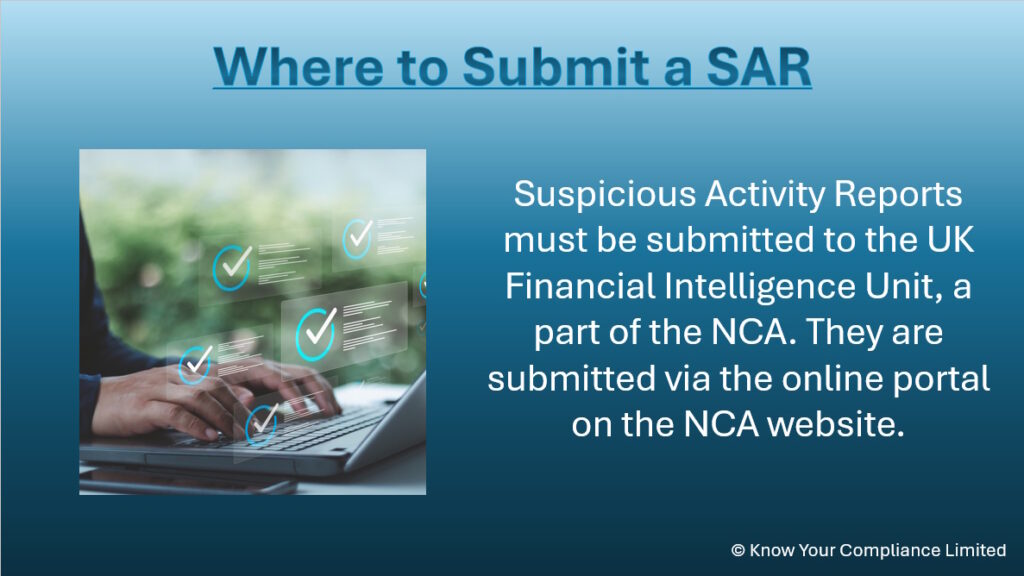
Where to Submit a SAR
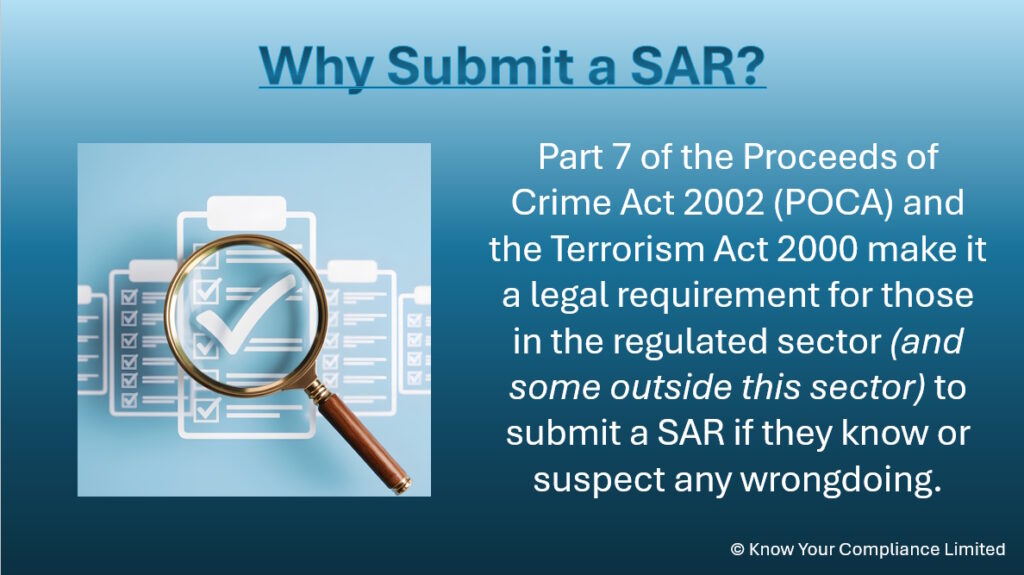
Part 7 of the Proceeds of Crime Act 2002 (POCA) and the Terrorism Act 2000 requires a regulated person or businesses to report suspicions of money laundering to the UK Financial Intelligence Unit (UKFIU). This unit is a part of the National Crime Agency (NCA).
Submitting a SAR provides regulators and law enforcement with valuable information on potential criminality. It also protects you, your business and UK financial institutions from the risks of money laundering.
When, Where and Why To submit an SAR!

How to Submit a Suspicous Activity Report (SAR)
SAR’s are submitted through NCA’s online portal and contain 5 sections regarding the suspicious activity: –
- Part I – Subject Information – Any name, address, social security or tax ID’s, birth date, driver’s license numbers, passport numbers, occupation and phone numbers of all parties involved with the activity.
- Part II – Suspicious Activity Information – Date Range and codes for the type of Suspicious Activity
- Part III – Information about Financial Institution where Activity Occurred
- Part IV – Filing Institution Contact Information – Can contain the contact information for the financial institution’s compliance officer or equivalent and list of any law enforcement agency that has been contacted while investigating the activity.
- Part V – Suspicious Activity Information – Narrative – A written description of the activity.
One report can be used multiple times and can provide invaluable information. It is not only essential to your legal obligation, but also a valuable tool for preventing and identifying money laudnering. The UK Financial Intelligence Unit receives over 460,000 every year!
Buy Suspicious Activity Reporting Procedures Template Now >